


Today the National Coordinator for Security and Counterterrorism (NCTV) published the Cyber Security Assessment Netherlands 2026 (Cybersecuritybeeld Nederland 2026). The warning is clear: our digital resilience is not keeping pace with the cyber threat. Preparation for quantum computers is lagging behind as well.
For organisations, the time a migration takes deserves particular attention. The move to quantum-safe cryptography can take five years or longer. That calls for decisions about people, systems and budgets well before a powerful quantum computer actually poses a threat.
How much preparation time does your organisation need? And what is that answer based on?
The day-to-day pressure is not going away
The NCTV finds that some organisations do not even have the basic measures in place. It is understandable that attention goes to vulnerabilities, access control, monitoring and recovery after incidents.
Quantum safety has to find a place within that same limited capacity. But waiting until every other security issue has been solved is not a workable plan.
Preparation becomes manageable once you know where the biggest risks and dependencies lie. Which information must stay protected for a long time? Which processes must not fail? Where could a change take a lot of time? With that insight you can free up capacity where it matters and avoid the whole organisation starting on an unmanageable migration all at once.
Why a migration to quantum-safe cryptography can take years
Post-quantum cryptography, usually abbreviated to PQC, is cryptography designed to withstand attacks by quantum computers as well. The move affects more than file encryption. Cryptography is also used to set up secure connections, verify identities and check digital signatures.
For a migration you need to know where those functions are used, which applications are vulnerable and who can make changes. A supplier may handle part of it. For other parts you are responsible yourself, or you depend on several parties at once.
The PQC Migration Handbook by the General Intelligence and Security Service (AIVD), CWI and TNO describes three phases for this: diagnosis, planning and execution. The National Cyber Security Centre (NCSC) also stresses the importance of an inventory of cryptographic assets.
In the end, such an inventory has to deliver more than a list of algorithms. You want to be able to establish, for example: this connection supports a critical process, uses quantum-vulnerable cryptography, is managed by this party and can be changed during this maintenance window. Only then can you decide on a well-founded order.
For long-lived systems in operational technology (OT), that feasibility deserves extra attention. What can be updated? What needs replacing? Which tests are needed before a change can responsibly be taken into use? Those are questions you want to ask early when the continuity of an installation comes first.
How long your data must stay protected also decides when to start
When a quantum computer will be able to break existing, widely used cryptography is uncertain. Even so, you can already assess today which data deserves extra attention.
Information that is confidential today may still be confidential in ten years. Think of trade secrets, sensitive files or information about critical infrastructure. Malicious actors can collect encrypted data to decrypt it later. That risk is known as harvest now, decrypt later.
A future migration does not retroactively protect data that has already been stolen. That is why, besides the migration time, the period during which data must stay secret also counts.
Ten years sounds like plenty. Until you do the maths.
Professor Michele Mosca's rule of thumb brings three periods together:
- The period during which your data must stay confidential.
- The time you need to migrate.
- The expected time until quantum computers can break the cryptography in use.
Take a simplified scenario: your data must stay protected for five years, the migration takes five years and you assume a quantum threat in ten years. Within those assumptions, all the room is used up. There is no margin for postponement or delay. If the migration takes two years longer, the plan no longer fits.
This is a scenario, not a prediction. Its value lies in the conversation that follows: which assumptions are we actually using, and how much uncertainty can we accept?
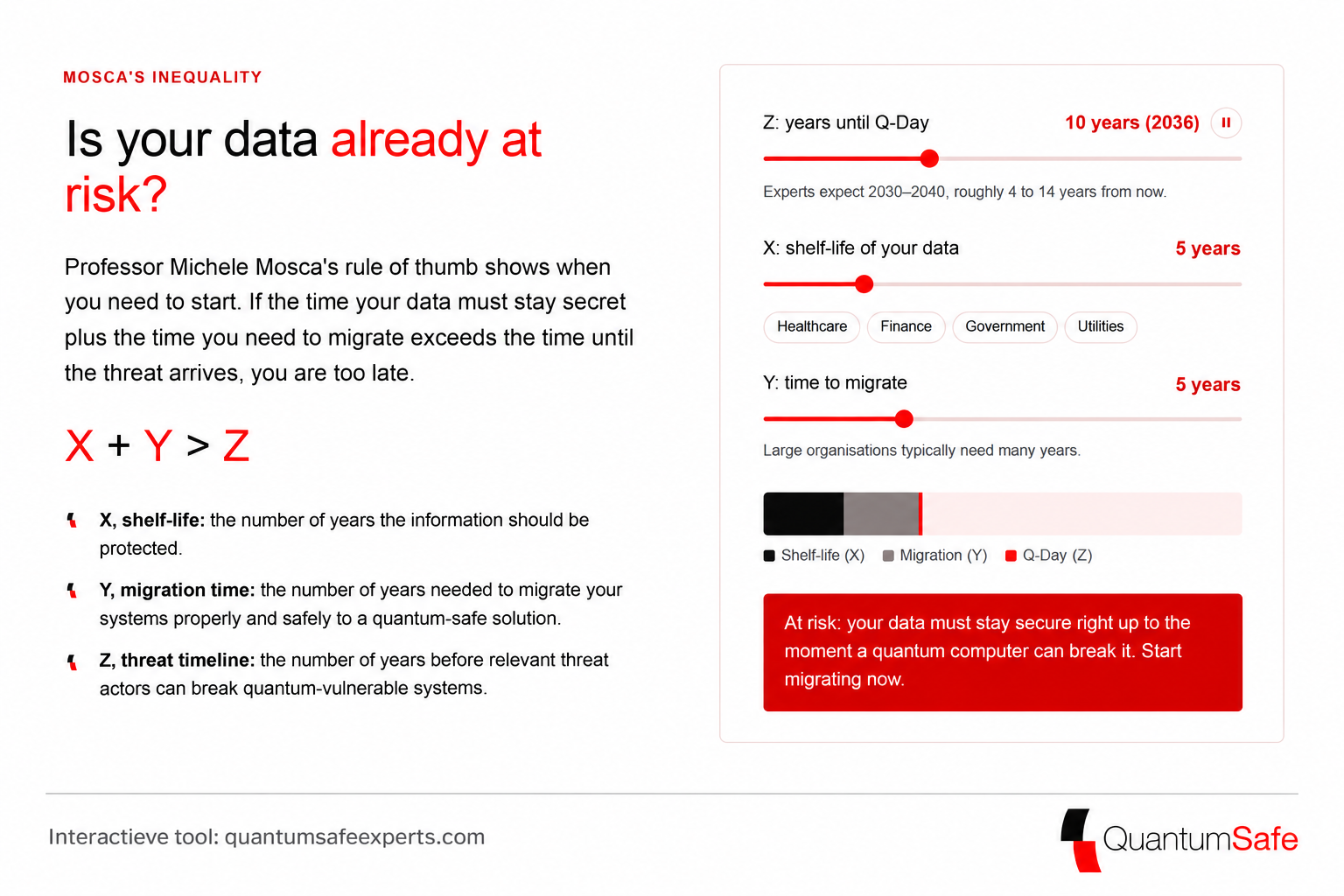
With the interactive Mosca tool on our homepage you can explore that trade-off. The outcome helps to put urgency on the table. For a migration decision, you then need insight into your own systems, data and dependencies.
What does your organisation need to know now?
A first exploration should give enough insight to make choices. Three questions help.
Where are we vulnerable?
Map which data and processes need protection and where they depend on cryptography. Link technical findings to the possible consequences for the organisation. That makes it clear why one application deserves attention before another.
What does change require of us?
Investigate which systems can be adapted, where the technical uncertainties lie and which dependencies determine the planning. A clearly scoped pilot can help test assumptions about compatibility, performance and management before you decide on a wider rollout.
How do we organise the execution?
Translate the findings into a roadmap with priorities, responsibilities and decision points. Make visible which expertise, capacity and investment are needed. Involve suppliers where their products or services are part of the solution.
That gives the board a basis for decisions and the technical teams a direction to work in. It also prevents an inventory from ending up as a report without follow-up.
From insight to execution with QuantumSafe
That is the connection we make with QuantumSafe. We combine subject-matter and technical expertise with the coordination needed to carry a change through an organisation.
Depending on the question, that starts with a board-level session or readiness assessment, with an inventory of cryptography, or with a clearly scoped technical pilot. The outcome has to support decisions: which risks do we tackle first, what needs technical investigation, and which people and resources does that take?
A pilot can, for example, test how an application handles PQC and what that means for compatibility and performance. The findings then become part of the roadmap, the agreements with suppliers and the guidance of the migration.
We also look at crypto-agility: the ability to replace or adapt cryptography in a controlled way while maintaining security and continuity. Techniques and insights will keep changing after this migration too. It helps if your organisation is set up for that.
The NCTV gives renewed reason to put the topic on the agenda. The preparation time needed makes it relevant to your planning today.
Want to know where your organisation stands? Contact QuantumSafe. Together we will decide which first step gives the most insight: a readiness assessment, an inventory of cryptographic dependencies or a targeted technical pilot. That creates a well-founded basis for the approach, planning and execution.
Sources and further reading
- NCTV – Cybersecuritybeeld Nederland 2026 (in Dutch). See in particular pages 28–29 on preparing for quantum computers and the migration to quantum-safe cryptography.
- NCSC – Wat is quantumveilige cryptografie? (in Dutch). An explanation of PQC, the risk of harvest now, decrypt later and the first preparation steps.
- AIVD, CWI and TNO – The PQC Migration Handbook. Guidelines for the diagnosis, planning and execution of a PQC migration.
- NCSC – Cryptographic Asset Discovery and Inventory. Research into making an inventory of cryptographic assets.
- NIST – Crypto Agility. Background on the ability to adapt cryptography and support future migrations.